Showing posts with label Belmont Books. Show all posts

Tuesday, September 4, 2018

Cry Shadow!


Cry Shadow! was the fourth Shadow paperback published by Belmont Books.   It was published on April 1, 1965.  Dennis Lynds authored the book and used the Maxwell Grant pen-name on the cover.


Compared with the other two Shadow stories I've read by Dennis Lynds, it wasn't as good as Shadow Beware.  I'm not saying it was a bad story or there was no action, it was good and well written, but just not as suspenseful and action-packed as Shadow Beware.  


Let me give a spoiler alert before I get into a brief review of the story.  I'm going to reveal information about the characters and the ending, so if you don't want to know them until after you read the book yourself, you may want to skip the next section!

The story begins with The Shadow stopping two thieves in an art gallery.  They are attempting to steal a pretty worthless statue, compared to anything else they could have taken!  While The Shadow questions the two thieves, one of them is killed by a poison dart.  That sets the story in motion as The Shadow discovers that the murdered two-bit art thief was actually a master craftsman at creating counterfeit money plates!  The Shadow uncovers an international counterfeit money ring, being run out of an old WWII German U Boat off the coast of New England.  An art gallery was shipping the counterfeit currency (American, Russian, etc.) around the world in hollowed out boards of its shipping crates.  By the end of the story, the counterfeiters are either dead or captured, the U Boat is sunk, and the counterfeit ring has been smashed by The Shadow!

The Shadow:
We learn a few new things about The Shadow and there is one big revelation about his past.  The minor things we learn are he uses both his mental powers and a special ointment to aid in the healing and recovery of two broken fingers.  He learned safecracking and lock picking techniques from Walter Pettibone.  The Shadow can speak most languages of the world.

The big revelation we have about The Shadow is found on pages 91 and 92 where it's revealed that Cranston served with the Office of Strategic Services (OSS) during World War II!  The OSS was an intelligence gathering organization of the United States that was founded in June 1942 and was dissolved in September of 1945.  It was the predecessor of the CIA.  We are told that Lamont Cranston had been a Colonel in the OSS and had "done much work against the forces of Facism in the war." (page 92)  On one mission, he had slipped into the heart of Japan aboard a PT boat!  This is awesome and interesting background!  In the Belmont book series, Lamont Cranston is always described as having blonde hair with some gray in it.  Supposing he was 20 years old when he joined the OSS in the early 1940's, he would be in his mid to late 40s during the time these stories take place (mid 1960s).   

The Shadow's sanctum is hidden in his offices as Lamont Cranston.  It is here - lighted only with a blue light - that The Shadow does much of his communicating with his agents.


In this story The Shadow uses the disguises of Lamont Cranston, and for the first time in this series he uses the disguise of Henry Arnaud!  Shadow fans will recognize that name as it is one of the frequent disguises used by The Shadow in the pulp stories.  Henry Arnaud is described as a business man and financier.  The Shadow uses a makeup kit to disguise himself as Arnaud.  Arnaud is taller than The Shadow and Lamont Cranston, so The Shadow wears special built up shoes to be taller.  Then, with special putty and fluid from a hypodermic needle injected beneath his skin, The Shadow molds his face to look like Arnaud's.  "...the broken and broad nose of Henry Arnaud appeared.  The nose was the result of Arnaud's early boxing career, and was well known to the world." (page 105)  The Shadow uses a special bridge to elongate his jaw, and special tape to make his left eye droop (another of Arnaud's boxing injuries!).  He uses a special dye to make his hair almost white.  "Finally, clenching his fist and narrowing his left hand with the plasticity of bone and sinew he learned from his years of yoga, he slipped on the ugly artificial hand, the reported result of losing his left hand in an automobile accident twenty years ago."

Agents:

Margo Lane.  Margo is described as The Shadow's most trusted agent.  She goes undercover twice in this story.  First, as Molly, a prostitute who becomes the girlfriend of a criminal The Shadow is tracking.  Second, as Ellen Morgan, secretary to Henry Arnaud (one of The Shadow's alter-egos).

Burbank.  Burbank does his usual role of facilitating communication between The Shadow and his agents.  We learn he records all agent reports and maintains these records.  He does deep investigation into records for The Shadow.

Stanley.  Stanley chauffers Lamont Cranston around in his Rolls Royce.  He's described as one of The Shadow's most trusted agents.

Moe Shrevnitz.  Shrevvy is described as small and peppery and wears a leather cap.  In this story he is used by The Shadow as a look out and observer while in his taxi cab.

These are the only agents in this book.  However, also included are regulars Detective Joe Cardona and Commissioner Weston.


Monday, July 23, 2018

Two Big Reveals in Cry Shadow!


I recently read the Belmont paperback Cry Shadow! published in 1965.  I'm reviewing my notes and will be writing up a full review - hopefully this week!  But there were 2 big reveals in the book I couldn't wait to share, so here they are!

1.  We learn a little bit more about Lamont Cranston's past as it is revealed that he served in the Office of Strategic Services (OSS) during World War 2!  The OSS was an intelligence gathering organization and the predecessor of the Central Intelligence Agency (CIA).  I'll fill in more details when I do my review of Cry Shadow! and will also need to update the biography of The Shadow from the Belmont paperback series.

2.  The Shadow uses the Henry Arnaud disguise/alter-ego in Cry Shadow!  Shadow fans probably recognize the Henry Arnaud name as it was one used by The Shadow in the pulp stories.  However, this is the first time it's been used in The Shadow Belmont series.  

I've taken pages of notes on Cry Shadow! and my goal is to have a full review of it by the end of this week.  But as a Shadow fan, I couldn't wait to share these two big reveals!


Sunday, July 8, 2018

The Shadow's Transformation

One thing that has always mystified me about the 1994 The Shadow movie concerns Lamont Cranston's transformation into The Shadow.  The first time we see The Shadow, it's like what we see on the covers of his pulp magazines - hawk-like nose, black slouch hat, black cloak, etc.  


Then we see him as a disheveled Lamont Cranston in the back seat of Moe's cab (after dropping Dr. Tam off at home) and orders Moe to take him to the Cobalt Club.  Gone is the hawk-like nose!

Why does Lamont Cranston transform into The Shadow?  I have been reading through the official movie magazine and other articles on the background of the movie to find something definitive but to no avail.  So here is my working theory on why Cranston transforms into The Shadow.  My theory goes to the time Cranston is taken captive and meets the Tulku, the mystic teacher who dwells in the Temple of the Cobra.  There the Tulku tells Cranston, "I also know that for as long as you can remember, you struggled against your own black heart and always lost. You watched your spirit, your very face change as the beast claws its way out from within you. You are in great pain, aren't you?  You know what evil lurks in the hearts of men, for you have seen that evil in your own...I will teach you to use your black shadow to fight evil." (Emphasis added)


Based on what the Tulku says, it is Cranston's struggle with his own evil, his own black heart, that causes a physical transformation.  In the past, that transformation led to evil acts.  But in his years of training with the Tulku, Cranston still goes through that physical transformation, but now he harnesses it for good!

That's my theory on why Lamont Cranston transforms into The Shadow.  On a side note, the movie comes very close to how The Shadow is portrayed in the 1960's Belmont Book Shadow series.  In that series, Lamont Cranston must put on the slouch hat, cloak, and girasol ring to become The Shadow and have full use of all the powers of the mind that he learned from a mystic teacher in the Orient.  I wonder if the Belmont Books had any influence on this part of the movie!?!?

A description of The Shadow from Belmont Books "The Shadow Strikes"

While I will always prefer The Shadow of the pulp stories, I really like the different shades and tones of his character in the 1994 movie.  My theory could be completely wrong but it was fun trying to piece it together.  If you have your own theory on why Cranston transforms into The Shadow, I'd love to hear it!


Monday, June 18, 2018

The Shadow: Biography According to the Belmont Book Series

I consider the Belmont Books Shadow series to be a different iteration of The Shadow and not as a continuation of the stories from the pulp magazines.  I don't say that to diminish these stories because they are interesting and entertaining.  However, The Shadow in these stories is quite different than the ones from the pulps and the radio.  While there are many similarities, there are also major differences.  (Please note that the information below is based on descriptions of The Shadow from The Shadow Strikes.)


The Shadow in the Belmont Books is a man of mystery.  He wears the black cloak, the black slouch hat, and the girasol ring.  His footwear is described as "...Oriental slippers, designed for the needs of judo and karate..." (The Shadow Strikes page 67).  These Oriental slippers allow The Shadow to make no sound as he walks.  The Shadow also carries a .45 automatic and keeps a ring of skeleton keys hidden in the folds of his cloak.  The Shadow's cloak, hat and ring are "folded into amazingly small size and hidden in their secret places within the clothes" of Lamont Cranston (The Shadow Strikes page 12).

A major difference about this Shadow is that he has to wear the cloak, hat, and ring to become The Shadow.  For it is only when he wears these items that he has the full powers and abilities of The Shadow!

The Shadow is described as having great muscular control, physical strength, agility, balance and hearing.  He has knowledge of many languages (The Shadow Strikes pages 30, 59).  He had studied in the Orient with several masters.  From the great Chen T'a Tze he learned the ability to cloud men's minds so as not to see him and to hypnotize them (but can only do so when wearing the cloak, hat and ring).  Master Chen T'a Tze had also taught him the art of shallow breathing, allowing him to slow down his breathing.  The Shadow has "remarkable recuperative powers" and knowledge of Oriental medicine that allows him to quickly recover from physical injury.

Additionally, in the Orient, The Shadow learned "the secret of bearing pain to the point of actually not feeling any but the most intense and sudden pain.  It had been the most difficult of the mysteries of Chen T'a Tze for The Shadow to master" (The Shadow Strikes page 82).  The Shadow is also able to put himself into a trance-like state of suspended animation that makes him appear as if he had died.   Not much information is provided about Chen T'a Tze other than he was a great Master who had trained Lamont Cranston in many ancient mysteries.

Some of the descriptions of The Shadow hearken back to the pulp magazine.  His face is not seen but his glowing, burning eyes can be.  The Shadow gives his sometimes mocking and sometimes triumphant laugh which chills the blood of the bad guys.  The Shadow is also a master of disguise.    

The Shadow's primary alter-ego is Lamont Cranston.  As Cranston, he is wealthy socialite business man, amateur criminologist, and close friend of NY Police Commissioner Weston.  In the book Cranston is described as having hawklike features, long fingers, and greying blond hair.  He has a private office in a Park Avenue building which also doubles as his secret base of operations.  Cranston also owns a town house with a private garage.  He is a wine connoisseur and has financed Kent Allard's expeditions.  This Lamont Cranston seems to be an amalgamation of the Cranston from the pulps and radio show!

Kent Allard is the other alter-ego used by The Shadow.  There is a real Kent Allard who is an explorer and adventurer, so The Shadow assumes his identity.  To become Kent Allard, The Shadow uses a sophisticated disguise (The Shadow Strikes pages 102-103)!  He uses a special dye to darken his hair and combs his hair straight back with no part.  If he has time, he will grow a mustache or use a fake mustache if in a hurry.  He injects a small wax-like fluid into the skin of his nose to change it from the hawklike nose of Cranston and into the thicker nose of Allard.  He uses his great muscle control to change his facial expression to that of Allard's and to walk slightly hunched over as Allard does due to the years of carrying heavy packs on his expeditions.  Finally, when disguised as Allard, The Shadow walks with a limp as the real Allard does as a result of a tiger attack while exploring the High Himalayas.  This is a clever reversal from the pulp magazines!  In the pulps, The Shadow is really Kent Allard but uses Lamont Cranston's identity.

The Shadow of the Belmont Books series is an interesting character that retains some of the qualities found in the pulps and the radio show.  However, you can see there's a lot of differences as well.  In my opinion, this Shadow was in direct competition with the likes of James Bond and other spies that were popular in the movies and on TV when this series was published (1960s).   


Sunday, February 11, 2018

Shadow Beware

Front Cover

Shadow Beware was the third Shadow paperback published by Belmont Books.  It was published on January 1, 1965.  Dennis Lynds authored the book and used the Maxwell Grant pen-name on the cover.

Back Cover

Compared with The Shadow Strikes, this was a much better story.  It's story-line was full of great twists, and it was written in a similar style to the pulp stories.  When I got to the last 60 pages or so, I couldn't put it down until I finished it.

Let me give a spoiler alert before I get into a brief review of the story.  I'm going to reveal information about the characters and the ending, so if you don't want to know them until after you read the book yourself, you may want to skip the next section!

The story begins in London - a bad part of London - and the murder of an American Peace Corps worker. George Paulson was a field supervisor with the Peace Corps stationed in New Guinea, so why was he murdered in an alley in the east end of London? And why would NY Police Commissioner Weston, Lamont Cranston and The Shadow be involved?  The murdered Peace Corps worker is George Paulson.  We soon learn that he was one of Commissioner Weston's homicide detectives, so Scotland Yard asks Weston to come and assist in the investigation.  Weston invites his friend and amateur criminologist, Lamont Cranston, to assist as well.

When Paulson was murdered, he was carrying a briefcase that had been stolen from his body.  He was found in an alley, smelling of booze, armed with a pistol in a waist holster, and had been shot once at point-blank range.  Paulson's Peace Corps supervisors knew nothing of his trip to London, and the US Embassy gets involved in the investigation as well when Embassy worker Jeff Byrd meets with Weston, Cranston and the investigators from Scotland Yard.

The Shadow's investigation leads him to travel to New Guinea, Australia, and Paris (disguised as Kent Allard).  And as Lamont Cranston/The Shadow he travels to Scotland where the mystery is solved and untangled.

We discover that George Paulson was actually working for the CIA undercover as a Peace Corps worker.  He uncovered a hi-jacking ring that substituted real drugs for watered down or fake drugs.  These were huge pallets of medicinal supplies used by the Peace Corps to help the people in New Guinea and various countries.  The fake/watered down drugs had caused the death of many people.  Paulson had found a clew on one of the last pallets and that is what lead him to London.  He was murdered by US Embassy worker Jeff Byrd, who was also a CIA agent working undercover in the Embassy.  Byrd murdered Paulson because he was in on the hi-jacking ring.  The mastermind behind the hi-jacking ring was Jasper Lorring, a Scottish businessman who once had a business deal with Lamont Cranston when he met him in the Cobalt Club in the past.

The Shadow deals death to the gang - using his bare hands and borrowed weapons.  In the end, The Shadow triumphs.  The Shadow says, "Evil begets evil and dies of its own horror."

In this book we learn that Lamont Cranston has an apartment and business office in London located on the top floor of a private hotel named The Lancaster.  It is in Kensington (west London).  In this office, in a secret room, is The Shadow's London sanctum.  It is described as "a room where a deep bluish light glowed from an unseen source..." (page 51).  In this sanctum he communicates with Burbank via a communication device activated by his girasol ring.  We also learn that when disguised as Kent Allard, he has an apartment in Paris on St. Germaine-Des-Pres.  It's also revealed that Lamont Cranston always takes a daily swim and he also smokes cigarettes (which was quite fashionable for James Bond type spies in the 60s!).

Locations:
Cobalt Club - mentioned as the place Lamont Cranston previously met the villain Jasper Lorring.
The Burgoyne Club - Lamont Cranston visits this club to take a steam bath and his daily swim.
The Lancaster - Cranston's apartment and business office in London.

Vehicles:
Lamont Cranston is chauffeured by Stanley in a Rolls Royce with a special engine.

1965 Rolls Royce


Lamont Cranston drives an Austin-Healy.

1965 Austin-Healy


Agents:

Margo Lane.  We learn that Margo has blue eyes.  She does some investigative work and is kidnapped by Jasper Lorring and rescued by The Shadow.

Burbank.  Burbank does his usual role of facilitating communication between The Shadow and his agents.  He also spearheads investigative work in New York while The Shadow is in London.

Stanley.  Stanley chauffers Lamont Cranston around London in his Rolls Royce.  We learn he carries a .45 automatic.  Interestingly, Stanley disguises himself as Lamont Cranston so The Shadow can continue his investigation outside of London!

Bombardier Bill Mace.  Bombardier is Shadow agent #109 and this is the first time he's mentioned.  He's a British army veteran and former English middle-weight boxing champion.  As The Shadow's agent, he portrays himself as a shady, punch-drunk former boxer.

Marcel Guyot.  Marcel is one of The Shadow's agents in Paris, this is his first appearance.  He is a taxi driver and his cab is equipped with a secret radio for communicating with The Shadow.

This story reveals that The Shadow has a network of agents worldwide.  Another interesting aspect of the story is his agents wear an opal ring that lights up and acts as a homing device to meet face to face with The Shadow.

The Shadow:
We learn a few new things about The Shadow.  We learn that he has the ability to see in darkness and through fog.  Even while sleeping he can detect the slightest disturbance in the air or hint of danger.  He can avoid detection from dogs.  He has extensive martial arts training and can kill with his bare hands.  He can use the power of his mind to open electronic locks, and to deaden the feelings of pain.  He uses his famous line, "The weed of crime bears bitter fruit" (page 154).  His voice and laugh are described as eerie, chilling and hard.  One of the best descriptions of The Shadow is on page 88, "Two burning eyes turned toward him and the girasol ring glowed red in the dark with enough light to show a sharp, hawk nose beneath the slouch hat of The Shadow."

In this story The Shadow uses the disguises of Lamont Cranston, Kent Allard and Phineas Twambly.  In his London sanctum, Cranston accesses a file on Kent Allard that tracks Allard's whereabouts!

Shadow Beware was an exciting adventure that I enjoyed reading.  It introduces us to some new Shadow agents and reveals a few new things about The Shadow and his alter-ego, Lamont Cranston.  I hope you've enjoyed this brief review of the book!

Sunday, February 4, 2018

The Shadow Belmont Book Covers

Belmont Books printed a series of The Shadow stories in the 1960s.  Here's a look at book covers and brief information about each one.

Return of The Shadow was published September 1, 1963.  It was written by Walter B. Gibson who had penned the vast majority of the original Shadow stories in the pulp magazines.  Interestingly, Gibson uses his own name and not his pen name of Maxwell Grant for this book!


The Shadow Strikes was published October 1, 1964 and was written by Dennis Lynds.  Lynds used the Maxwell Grant pen name for this story and the rest of The Shadow stories he wrote.  (I've written two articles about this book which you can read here and here.)


Shadow Beware was published January 1, 1965 and was written by Dennis Lynds.


Cry Shadow! was published April 1, 1965 and was written by Dennis Lynds.   As you can see, it uses the same Shadow silhouette on the cover as the previous book.


The Shadow's Revenge was published October 1, 1965 and written by Dennis Lynds.  This cover uses artwork from the November 1, 1936 The Shadow magazine! 

Here's the original artwork from the
Nov 1, 1936 Shadow magazine

Mark of The Shadow was published May 1, 1966 and was written by Dennis Lynds.  This cover features a more classic looking Shadow!


Shadow-Go Mad! was published September 1, 1966 and written by Dennis Lynds.   


The Night of The Shadow was published November 1, 1966 and was written by Dennis Lynds.  I like the back cover with the big yellow question mark!


The Shadow-Destination: Moon was published March 1, 1967 and was written by Dennis Lynds.   Interestingly, it wasn't until July 20, 1969 that man first landed on the moon!


It's interesting to see how the covers started with a more modern (1960s) look but by the end of the series they had transitioned to a more classical Shadow artwork covers.  I've not been able to find a lot of information about the series and how well received it was - but I'll keep digging and sharing what I find.  


Sunday, December 3, 2017

The Shadow Strikes! (Part Two)

I had previously written about The Shadow Strikes! story as published by Belmont Books.  You can read that article here.  In this article I will dive into the character of The Shadow as presented in The Shadow Strikes!


Let me say at the very beginning that I consider the Belmont Books Shadow series to be a different iteration of The Shadow and not as a continuation of the stories from the pulp magazines.  I don't say that to diminish these stories because they are interesting and entertaining.  However, The Shadow in these stories is quite different than the ones from the pulps and the radio.  While there are many similarities, there are also major differences.

The Shadow in the Belmont Books is a man of mystery.  He wears the black cloak, the black slouch hat, and the girasol ring.  His footwear is described as "...Oriental slippers, designed for the needs of judo and karate..." (page 67).  These Oriental slippers allow The Shadow to make no sound as he walks.  The Shadow also carries a .45 automatic and keeps a ring of skeleton keys hidden in the folds of his cloak.  The Shadow's cloak, hat and ring are "folded into amazingly small size and hidden in their secret places within the clothes" of Lamont Cranston (page 12).

A major difference about this Shadow is that he has to wear the cloak, hat, and ring to become The Shadow.  For it is only when he wears these items that he has the full powers and abilities of The Shadow!  


From page 13 of The Shadow Strikes!

The Shadow is described as having great muscular control, physical strength, agility, balance and hearing.  He has knowledge of many languages (pages 30, 59).  He had studied in the Orient with several masters.  From the great Chen T'a Tze he learned the ability to cloud men's minds so as not to see him and to hypnotize them (but can only do so when wearing the cloak, hat and ring).  Master Chen T'a Tze had also taught him the art of shallow breathing, allowing him to slow down his breathing.  The Shadow has "remarkable recuperative powers" and knowledge of Oriental medicine that allows him to quickly recover from physical injury.  

Additionally, in the Orient, The Shadow learned "the secret of bearing pain to the point of actually not feeling any but the most intense and sudden pain.  It had been the most difficult of the mysteries of Chen T'a Tze for The Shadow to master" (page 82).  The Shadow is also able to put himself into a trance-like state of suspended animation that makes him appear as if he had died.   Not much information is provided about Chen T'a Tze other than he was a great Master who had trained Lamont Cranston in many ancient mysteries.

Some of the descriptions of The Shadow hearken back to the pulp magazine.  His face is not seen but his glowing, burning eyes can be.  The Shadow gives his sometimes mocking and sometimes triumphant laugh which chills the blood of the bad guys.  The Shadow is also a master of disguise, and in this story he disguises himself as explorer Kent Allard and Phineas Twambley (a disguised used in several of his pulp magazine adventures).  The Shadow uses a couple of his well known catch phrases:  "The weed of crime bears bitter fruit" (page 112) and "The Shadow knows what evil lurks in the hearts of men" (page 127).

The Shadow's primary alter-ego is Lamont Cranston.  As Cranston, he is wealthy socialite business man, amateur criminologist, and close friend of NY Police Commissioner Weston.  In the book Cranston is described as having hawklike features, long fingers, and greying blond hair.  He has a private office in a Park Avenue building which also doubles as his secret base of operations.  Cranston also owns a town house with a private garage.  He is a wine connoisseur and has financed Kent Allard's expeditions.  This Lamont Cranston seems to be an amalgamation of the Cranston from the pulps and radio show!

Kent Allard is the other alter-ego used by The Shadow.  There is a real Kent Allard who is an explorer and adventurer, so The Shadow assumes his identity.  To become Kent Allard, The Shadow uses a sophisticated disguise (pages 102-103)!  He uses a special dye to darken his hair and combs his hair straight back with no part.  If he has time, he will grow a mustache or use a fake mustache if in a hurry.  He injects a small wax-like fluid into the skin of his nose to change it from the hawklike nose of Cranston and into the thicker nose of Allard.  He uses his great muscle control to change his facial expression to that of Allard's and to walk slightly hunched over as Allard does due to the years of carrying heavy packs on his expeditions.  Finally, when disguised as Allard, The Shadow walks with a limp as the real Allard does as a result of a tiger attack while exploring the High Himalayas.  This is a clever reversal from the pulp magazines!  In the pulps, The Shadow is really Kent Allard but uses Lamont Cranston's identity.

The Shadow of the Belmont Books series is an interesting character that retains some of the qualities found in the pulps and the radio show.  However, you can see there's a lot of differences as well.  In my opinion, this Shadow was in direct competition with the likes of James Bond and other spies that were popular in the movies and on TV when this series was published.    While I enjoyed reading this book I found myself missing the classic Shadow character from Walter B. Gibson's works.  I plan on reading the entire Belmont Shadow series and writing about them here on the blog.  I hope you found this article informative and entertaining!


Saturday, November 18, 2017

The Shadow Strikes! (Part One)

Front Cover

The Shadow Strikes was the second Shadow paperback published by Belmont Books.  It was published on October 1, 1964.  Although it has Maxwell Grant as the author, it was actually written by Dennis Lynds.

Back Cover
This Shadow adventure is a clear departure from all other published Shadow stories up to this time.  While Shadow fans will recognize many of the names and places from previous stories, they will also see that things have changed and this story was set in a contemporary setting (1960s).  

In this story, The Shadow investigates the death of a man named Anton Pavlic.  While the police claim Pavlic died as a result of accidental murder (he was hit by a car!), The Shadow knows there is something more sinister behind the simple facts.  His investigation leads to the unveiling of a blackmail scheme being run by an organization that, on the front, was set up to help refugees from communism.

The Shadow drives a Jaguar.  It is a small, custom-built car with a supercharged engine.  It is also equipped with a car telephone!

1964 Jaguar - could this be The Shadow's?

1964 Car Phone

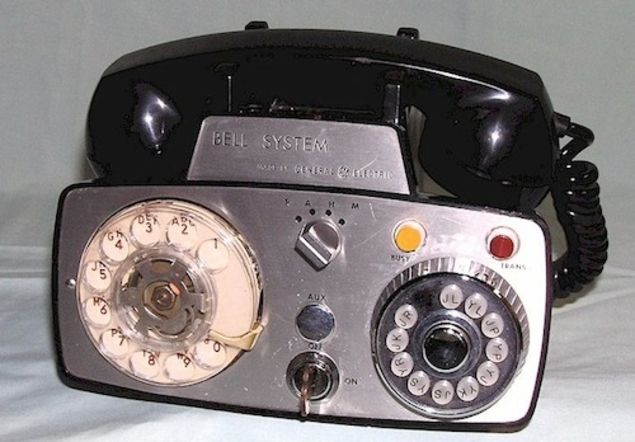
I did a little research and was amazed to find that in 1964 there were over 1 million Americans using car telephones!  Above is an example of a 1964 car phone, but I'm sure The Shadow's was more high-tech than what you would buy over the counter!

As I mentioned, there are familiar faces and places in this Shadow story.  We have Lamont Cranston visiting the Cobalt Club.  Cranston is a good friend of Police Commissioner Weston, and in this story Cranston assists Detective Joe Cardona.  All of these characters and places are straight from The Shadow pulp and radio stories.

The Shadow also has a team of agents that assist him, just as he did in the pulps.  But again, there are some updates and changes.  Here are The Shadow's agents from The Shadow Strikes:

Stanley:  Stanley is The Shadow's chauffer and is an ex-police officer.  He carries an automatic, handcuffs and lock picks. (Stanley was Lamont Cranston's chauffer in the pulp magazines.)

Burbank:  Burbank is the hub of The Shadow's team as agents report to Burbank and Burbank reports to The Shadow.  

Shrevvy:  Shrevvy is described as a small, peppy taxi driver.  He assists The Shadow with transportation needs.

Clyde Burke:  Clyde is a reporter as well as friend and associate of The Shadow.

Margo Lane:  Margo is described as dark-haired and slim.  She is the private secretary of Lamont Cranston as well as a friend and operative of The Shadow.  Margo is from Denver, Colorado and was a theater major in college.  She goes under cover to assist The Shadow in this story. 

Unlike the pulp magazines, The Shadow's agents listed above all know his identity and are a part of his crime fighting organization.  I'll write more about The Shadow in an upcoming article!

This was an exciting and well-written story.  While it was a departure from the historic Shadow character, I liked it as a new iteration of The Shadow.  It wasn't quite the page-turning adventure I enjoy from Walter B. Gibson, but it was a fun and entertaining book to read.

In an upcoming article I will write extensively about The Shadow in this story and highlight his character, gadgets and abilities.  I hope you've enjoyed this brief look at The Shadow Strikes!!!


Saturday, September 9, 2017

The Shadow: Belmont Book Series


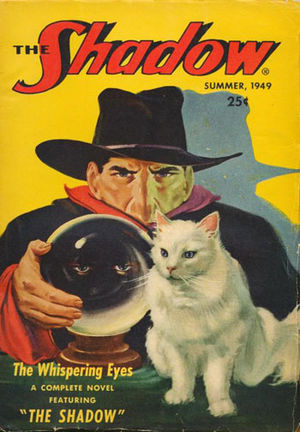
The last The Shadow pulp magazine published in the summer of 1949 with the Walter B. Gibson (writing as Maxwell Grant) story, "The Whispering Eyes."  There were no new Shadow stories until on September 1, 1963, Walter B. Gibson's story "Return of The Shadow" was published by Belmont Books in a paperback.


Belmont published a total of nine Shadow paperback stories.  While Walter B. Gibson wrote the first one ("Return of The Shadow"), Dennis Lynd would write the following eight stories under the pen name of Maxwell Grant.  These new stories placed The Shadow in modern times (the 1960s) and made some changes to The Shadow's skills and abilities.  There were familiar names and places in these stories (Harry Vincent, Commissioner Weston, the Cobalt Club, etc.) but The Shadow was cast as being more of a spy than a crime fighter.

Here is the list of the Belmont Shadow paperbacks including the author and publishing date:
  • Return of The Shadow, by Walter B. Gibson,  published September 1, 1963
  • The Shadow Strikes by Dennis Lynds (as Maxwell Grant), published October 1, 1964
  • Shadow Beware by Dennis Lynds (as Maxwell Grant), published January 1, 1965
  • Cry Shadow! by Dennis Lynds (as Maxwell Grant), published April 1, 1965
  • The Shadow's Revenge by Dennis Lynds (as Maxwell Grant), published October 1, 1965
  • Mark of The Shadow by Dennis Lynds (as Maxwell Grant), published May 1, 1966
  • Shadow-Go Mad! by Dennis Lynds (as Maxwell Grant), published September 1, 1966
  • The Night of The Shadow by Dennis Lynds (as Maxwell Grant), published November 1, 1966
  • The Shadow-Destination: Moon by Dennis Lynds (as Maxwell Grant), published March 1, 1967
I have a copy of "Mark of The Shadow" and have started reading it, but I must say it's not as well written as the Walter B. Gibson stories.  Additionally, there are some things I don't particularly like about the 'new' Shadow.  For example, Lamont Cranston is The Shadow but he has to become The Shado!.  On page 26 we read, "The power to cloud men's minds, learned so long ago from the great Chen T'a Tze, required the secret black cloak, the black slouch hat, and the fire-opal girasol ring.  The power was not in these things, it was a power of the mind, it's source was not known even to Chen T'a Tze, but it could not be used without the cloak, the dark hat, the glowing ring on the long finger of The Shadow."


I'm trying to collect the entire Belmont Shadow paperbacks, and will post overviews and reviews of them as I read through them.  While I am a big fan of the original 1930s and 40s Shadow stories, I'm interested to see a different take on the character.