Sunday, January 3, 2021

January 1, 1942 - Alibi Trail

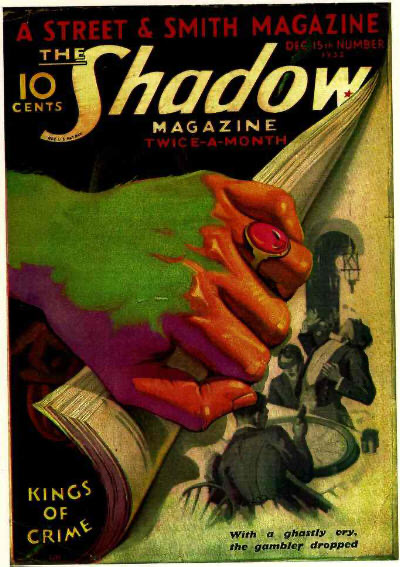
 Happy New Year!  Here's a brief look at the cover of The Shadow magazine that printed on January 1, 1942 with the story "Alibi Trail."


I really like the looks of this Shadow cover!  The Shadow is in action, taking out the foeman right in front of him with the danger of another mobster directly behind him.  

I haven't read this story yet, but hopefully it has as much action as the cover depicts.


Friday, May 15, 2020

Currently Reading - Kings of Crime


I have started reading this paperback issue of The Shadow story, Kings of Crime.  This issue was published by Pyramid Books in February 1976.  It features nice cover artwork by Jim Steranko.  It is the classic Shadow with an automatic in one hand and the ace of spades in the other.  A skeleton holds 4 king cards, each with a different thug and weapon!

I also like that Pyramid includes the "From The Shadow's private annals as told to Maxwell Grant."  This was a feature of the pulp magazines that I really liked and am glad they carried it over to their paperbacks.


The original pulp issue of Kings of Crime published on December 15, 1932.


Pyramid Books (which became Jove Books) published a total of 23 of The Shadow's stories.


Sunday, May 10, 2020

The Shadow Knows....May is Skin Cancer Awareness Month!


Ok, so this post really has nothing to do with The Shadow, but I did want to share that May is Skin Cancer Awareness Month.  

Skin Cancer is not something that was on my mind too much in the past.  Then, several years ago, I lost an uncle to Melanoma.  And recently I've had my own experience with skin cancer.  I had a spot removed from my leg that turned out to be benign.  But last year I went through 4 surgeries to remove skin cancer from my face and then have reconstructive surgery to repair the holes in my skin that were left from removing the skin cancer.  This week I have another round of surgeries to remove skin cancer from my left ear.  I am not sharing this for pity - I'm sharing this because skin cancer is real, it should be taken seriously, and you should make checking your skin a regular part of your health care.  

Here are some facts to consider:

  • There are over 5 million new cases of skin cancer diagnosed each year in the US
  • 1 in 5 Americans will develop skin cancer by age 70
  • 2 people die of skin cancer every hour


For more information, you can check out these web sites:
Skin Cancer Foundation
American Cancer Society

Ok, so skin cancer does have something to do with The Shadow now that I've thought about it.  I avoid too much exposure to the sun by staying in the shadows!  I know this was a different type of post, but I am trying to play a small part in letting people know about skin cancer during this month of Skin Cancer Awareness.


Saturday, February 15, 2020

The Shadow Annuals

The Shadow had an impressive publishing run from 1931 to 1949.  One mystery to me is why there were only 3 Shadow annuals published over that stretch of time?  I don't have an answer yet but will keep digging.  Here's a brief look at the 3 Shadow annuals.

The first The Shadow Annual published in 1942.  It featured a cover of The Shadow in the guise of Lamont Cranston.  It featured the following Shadow stories:  The Living Shadow, The Ghost Makers, and The Black Hush.  It was 144 pages, and based on what I can find, Graves Gladney was the artist for the cover.


The second The Shadow Annual published in 1943.  The cover states, "A selection of the best Shadow novels."  It contained the following Shadow stories:  The Voodoo Master, Hidden Death, and The Gray Ghost.  I've not found a difinitive answer to who the cover artist was.  I've seen the artwork attributed to George Rozen, Modest Stein and Graves Gladney.


The third and final The Shadow Annual published in 1947.  The stories in this issue are:  No Time for Murder, Toll of Death, and Murder by Magic.


As I find more information on these three Annuals, I'll be sure to update this article!!!


Thursday, August 29, 2019

Two Year Anniversary!

Today marks the second anniversary of this Shadow blog.  I say thank you to each person who takes time out of their day to stop by my blog and look around.  I sincerely hope you find it worth your time!

Things have been busy for me the past several months so my posts have been pretty sporadic.  I hope to be able to get to a more regular cadence of posting.


Sunday, August 18, 2019

A Shadow Comics Mystery - A Question of Character!


When Shadow Comics first began to be published, The Shadow character of the comics mirrored the character of the pulp magazine.  Many, if not all, of the first Shadow Comics were based on stories straight out of the pulps.  But then in the 11th edition of Shadow Comics (published April 25, 1941*) the editors let us know that The Shadow of the comics will now mirror the character from The Shadow radio show!

From Editors note in Shadow Comics 11 (sorry it's blurry!)

The editor tells the readers, "In this issue we show THE SHADOW in pictures for the first time doing the "invisible man" act.  THE SHADOW in the comics is now exactly the same as THE SHADOW over the radio.  You'll be thrilled by it!"  The story in Shadow Comics 11 is from the radio show as well - The Leopard Strikes (which aired on January 5, 1941.)!

This is a mystery to me!  The Shadow radio show was only in it's 4th season and while the radio show was very popular and successful, had it eclipsed the popularity of the pulp magazine?  Was The Shadow character of the radio show more popular than the character of the pulps?  Or could it be that The Shadow character of the radio show better lent itself to the pages of a comic book (and its intended audience) than did the character of the pulps?

I don't have an answer to this mystery but found it quite an interesting development in the history of The Shadow.


*Mike's Amazing World of Comics


Sunday, July 7, 2019

Norgil the Magician


Did you know that Walter B. Gibson created another character named Norgil the Magician?  Not only did Gibson write the vast majority of The Shadow stories, he also created the character of Norgil the Magician and penned over 20 short-stories featuring Norgil.  

November 1937 edition of Crime Busters

The first Norgil story was published in November of 1937 in Street and Smith's Crime Buster pulp.  In all, 23 Norgil stories were published.  Just like The Shadow, Gibson wrote using the Maxwell Grant pen name.  Norgil the Magician has a supporting cast made up of Miriam, his assistant and Fritz his stage assistant.

The Mysterious Press reprint

In 1977 and 1979, a collection of the original Norgil stories were published by The Mysterious Press.  These books featured original cover art by Jim Steranko and introductions by Walter B. Gibson.  Only 16 of the 23 Norgil stories were collected in these two books.

Sanctum Books has republished some of the Norgil stories in their reprints of The Whisperer.

Sanctum Books reprint of The Whisperer

While I have not read a single Norgil story, I am looking forward to reading them and getting to know this character.  Based on what little I do know, he sounds like a bit of Mandrake the Magician and The Shadow mixed together!  I know Walter B. Gibson was a master magician himself so I'm sure his knowledge and craft was woven into the stories.  Hope you've enjoyed this brief look at another one of Gibson's great pulp characters!


Monday, July 1, 2019

25th Anniversary of The Shadow Movie!


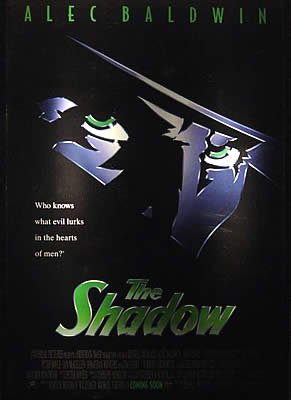
July 1 marks the 25th anniversary of the 1994 The Shadow movie which starred Alec Baldwin as Lamont Cranston/The Shadow and Penelope Ann Miller as the lovely Margo Lane.

The movie debuted as the number 2 film, up against stiff competition from Disney's The Lion King.  Unfortunately, it didn't carry the momentum into the following weeks and didn't have a long run at the box office.  Because of its poor reception, plans for sequels were ended.

I personally love this movie.  It  has the right blend of The Shadow's attributes from the pulps and the radio show.  When Alec Baldwin is The Shadow, he looks like he's ripped from the cover of one of the pulp stories.  Yes, it is not a perfect film, but it is the best Shadow film ever made!

Here's a link to articles on my blog about the 1994 film:  1994 The Shadow Movie


Sunday, May 12, 2019

The Shadow Strikes


The Shadow Strikes is a Shadow movie that was released on October 29, 1937 and starred Rod La Rocque as Lamont Cranston/The Shadow.  The movie is based on the pulp story "Ghost of the Manor" that published on June 15, 1933 (it was the 32nd Shadow magazine published).  The Shadow Strikes was the very first Shadow movie made.


Rod La Rocque stars as Lamont Cranston/The Shadow.  In the film, Cranston is an attorney and amateur criminologist.  This Lamont Cranston has more in common with the radio version of The Shadow than the version from the pulps (Note:  The Shadow radio show first aired on September 26, 1937, approximately 4 weeks before the movie premiered.).  We only see Cranston sneaking about as The Shadow a few times in the movie, and each time he is wearing a black cloak and short brimmed fedora - nothing like the cloak and slouch hat from the pulps.  There are no agents, no sanctum and no disguises!  But this Shadow does pack an automatic.

The Shadow


Rod La Rocque

I don't want to write extensively about the film, so here is a brief summary from IMDb:  "Lamont Cranston assumes his secret identity as "The Shadow", to break up an attempted robbery at an attorney's office. When the police search the scene, Cranston must assume the identity of the attorney. Before he can leave, a phone call summons the attorney to the home of Delthern, a wealthy client, who wants a new will drawn up. As Cranston meets with him, Delthern is suddenly shot, and Cranston is quickly caught up in a new mystery."

Here are some of my observations and notes on the film:

  • Lamont Cranston's father was a famous attorney who was murdered and Cranston is working to find the murderer (although this storyline does not play a part in the film).
  • Cranston assumes the identify of attorney Chester Randall but there are no disguises, etc.
  • At the end of the movie, Cranston explains what happened to the real Chester Randall.
  • Cranston and his butler/chauffeur use some type of a radio device to listen in on the owner of a gambling joint.  


The first time I watched this movie, I couldn't stand it and turned it off after five or ten minutes.  I watched it again recently and found it was a bit more bearable.  I personally don't care for the movie and am curious how well it did at the box office and how well it was received by Shadow fans.

Another interesting note is how the movie makes the Lamont Cranston character more like the radio character than The Shadow of the pulps.  Although the movie came out a month after the radio show premiered, it may have been in production and may have been influenced by the radio show.  That's my conjecture but I have no solid proof of it!

The Shadow Strikes was followed up a year later with Rod La Rocque once again playing Lamont Cranston in the film, International Crime.  Fans of The Shadow may enjoy watching this film, but if you are looking for a movie that is like The Shadow of the pulps, then this isn't the movie for you.   I really tried hard to like this move, but I just couldn't.  If you haven't watched this movie you can find it on DVD and on streaming services such as Amazon.  While it's not a great Shadow movie (in my opinion) it is the first Shadow movie made and was an attempt to bring the character to the silver screen!


Saturday, May 4, 2019

Harry Vincent's Hometown

A few days ago I was reading The Shadow story, "The Crime Cult" (this story was originally published on July 1, 1932.  I was reading the Pyramid paperback edition.) and ran across one little sentence that got me started on an investigation into Harry Vincent's hometown!  

On the bottom of page 25 I read the following:  "Matters had been quiet during the past month, and Harry had been considering a short trip to his Michigan home in the little town of Colon."  When I first read that, I thought Colon, Michigan must be a made up town.  Then I thought, if it is a real town in Michigan, why would Walter B. Gibson (Maxwell Grant) use it as Harry's hometown?  With Harry's hometown clew, I began to investigate if it was a real town or not!

To my surprise, Colon, Michigan is in fact a real town - more accurately, it is a village!  It is in southern Michigan and was incorporated as a village in 1904.  The village of Colon takes up only 1.75 square miles and according to the 2010 census has a population of 1,173 people.  That answered my first question as to whether or not Colon, Michigan was a real place.  


Undated photo - but I'm guessing from the 1930s.
This must be what it looked like when Harry Vincent lived there!

Now I had to press on to answer my next question - why would Walter B. Gibson use a small village in Michigan as Harry Vincent's hometown?  My investigation revealed that Colon, Michigan is known as "The Magic Capital of the World!"  In 1925, the magician Harry Blackstone, Sr moved to the little village and it became the base of operations for him and his crew.  Colon is also the home of the Abbott Magic Company and several other magic companies.  Blackstone is buried in the Colon cemetery.

Magician Harry Blackstone, Sr was a personal friend of Walter B. Gibson and Gibson himself was a magician of renown!  Gibson was Blackstone's ghost writer on several books and Gibson himself wrote many books on magic and even invented several magic tricks.  I believe it is that magical connection that led Gibson to pick Colon, Michigan as Harry Vincent's hometown.  It makes me wonder if Gibson and Blackstone had a good chuckle together when this story published and if any of The Shadow's readers made the connection between Colon, Michigan and Gibson!

With that one clew of Colon, Michigan I was able to unravel the mystery behind Harry Vincent's hometown!


Sunday, April 21, 2019

Shadow Comics - A Plea From The Shadow!

In a previous post, I shared from several Shadow Comics how they detailed The Shadow's power to cloud men's minds.  I referenced in particular Shadow Comics #19 (published August 28, 1942) and an article in that comic that gave full detail of how The Shadow gained this power.  

I have finally found a copy of that article and was able to read it in its entirety.  Below are screen captures of the article!


According to the article, it is a plea from The Shadow to stop asking him to share his knowledge on how to cloud men's minds.  That power was won by The Shadow on his own merits and he cannot share that knowledge with anyone.  That power and ability is The Shadow's and his alone!


Sunday, March 31, 2019

The Shadow and the Golden Master


The Shadow and the Golden Master is a hardback book which published in 1984 by The Mysterious Press.  It was written by Walter B. Gibson, who wrote The Shadow stories using the pen-name Maxwell Grant.  

The book itself collects The Shadow's first encounters with the master villain Shiwan Khan as originally published in the September 15, 1939 (The Golden Master) and December 1, 1939 (Shiwan Khan Returns) issues of The Shadow magazine.  As it states on the inside flyleaf, "Reproduced in facsimile from their original pulp magazine publication, these two full-length novels are for all who recall the thrilling adventures of The Shadow, and for all those who love tales of non-stop excitement."

Graves Gladney's artwork for the September 15, 1939 issue of The Shadow is used as the cover for the book.  On the back of the book is a picture of Walter B. Gibson.


Here are a few examples of pages inside the 114 page book.


The story The Golden Master was used as a basis for the 1994 The Shadow movie!  This is a great hardback collection of two stories that pit The Shadow against a master villain.  If you get an opportunity to add this book to your Shadow collection, I highly recommend you do so!!


Sunday, February 17, 2019

The Shadow, Jr


In Shadow Comics #69 (on newsstands October 25, 1946*) a new character is introduced - The Shadow Jr.!  The Shadow Jr. is even announced on the comic cover where it proclaims "Shadow Jr. a new Shadow for youth!" (look towards the bottom of the cover)

The Shadow story, "The Winged Dagger!" is where we first meet The Shadow Jr.  The story begins with Lamont Cranston receiving a telegram from Donald Jordan.  Donald is the son of Lamont's friend, Harry Jordan.  Donald's telegram states Lamont is Harry's only living friend and he asks him to help as Harry has been murdered.


Lamont flies to Tibet, where he learned the secret of clouding men's minds.  At the lamastery, Lamont meets young Donald Jordan and one of the Lamas.  Cranston learns more details behind his friend Harry's murder and then goes on the hunt for more clews.  He ultimately finds a small Axis base of operations where evil men are using a cyclotron to try and make their own atomic bomb!  Cranston, as The Shadow, encounters another person that has his same powers of invisibility - it is young Donald Jordan!


Both The Shadow and Donald destroy the cyclotron and the evil Axis members along with it.  Donald asks if he can leave Tibet with Lamont.  He tells him, "I would like to devote my life to your fight!  Against evil and evil doers!"  Cranston allows Donald to come with him and tells him, "I don't want you to think I'm doing you a favor.  By coming with me..you'll earn your way.  Now at last...I'll be able to be in two places at once...you and I working together."


Donald Jordan only appeared in two other Shadow Comics (#74 and #77).  In Shadow Comics #74 his name is Donnie Dart.  


I'm not sure why they changed it from Donald Jordan!  It appears The Shadow Jr. experiment in the comics didn't catch on or fans didn't like the character.  Either way, he only appeared in a total of three Shadow Comics.  


*Mike's Amazing World of Comics

Monday, January 14, 2019

The Shadow Magazine #181

I've been able to add a new issue to my The Shadow magazine collection.  It's the September 1, 1939 issue (the 181st issue in The Shadow series) which featured the story, "The Crime Ray."


What really got my attention was the cover (art by Graves Gladney).  The cover features Lamont Cranston getting the third degree from Detective Joe Cardona!  The cover proclaims, "Not even Joe Cardona thought of connecting Lamont Cranston, being grilled under the glaring light, with The Shadow!"  The cover price was 10 cents.


cover close-up

The table of contents indicate there is a complete Shadow novel as told to Maxwell Grant!  It also includes three "thrilling stories" and regular Shadow magazine features of The Shadow Club, Codes, and Highlights on The Shadow.


Here are some pages from the inside of the magazine.  


The back page is a full page ad for Lucky Strikes cigarettes.


There are a couple of interesting things about this issue.  First, in the Highlights on The Shadow section it talks about the upcoming issue of The Shadow that readers won't want to miss, for the next issue will be the premier of Shiwan Khan!  They also say that readers will want to get the cover, painted by Graves Gladney, and frame it!  

The second item of interest is the mention of a Shadow photo that would be available to readers, they just had to mail in a 3 cent stamp to receive it.  However, prior to that, readers would have to cut out and mail in 3 coupons for the picture.   It says, "you'll have a nice print suitable for framing to put in your room, den, or club rooms.  The Shadow's signature is printed in the bottom corner, and the picture is on card stock strong enough to be tacked to a wall without a frame."  This is my first time hearing of such a photo - do any Shadow fans know what this photo looked like?

I hope you enjoy this brief look at the September 1, 1939 issue of The Shadow magazine!


Sunday, December 16, 2018

Gats Hackett - Greatest Shot in the Underworld


Gats Hackett is the leader of a minor New York gang in The Shadow's Shadow (February 1, 1933) story.  Even though he leads a minor gang, he plays a big part in the story!  Gats Hackett is working with Douglas Carleton and international crook Felix Zubian in a plot to steal diamonds.  The three know that they need to get rid of The Shadow.

The physical description of Gats is that he is a little chunky, but has a firm face with crude features that gave him a wolfish expression.  His mannerisms were crude as well.  Another telling description of this gangster is that he has an evil heart and fiendish spirit.  In the underworld, Gats was famous for his aim and was known as the greatest shot in the underworld.

Gats got his moniker because of the two gats he carried, sometimes in a briefcase but mostly in shoulder holsters.  His weapons of choice were described as huge .45 revolvers.  These two gats of Gats, along with his excellent aim, were his gangdom claim to fame.

Gats puts his revolvers to work several times in the story.  The first time is when he springs a trap on The Shadow and chases him down in a spectacular car chase.  Gats empties his guns into the car The Shadow was driving, only to learn The Shadow had escaped.  The next time he unleashes his twin smoke wagons are when he sets up a hit on Lamont Cranston in the Holland Tunnel.  Once again Gats unleashes his .45s only to find he's missed his prey.  The final time he uses his guns is at the end of the story when he faces off against The Shadow.  I'll tell about that in just a moment!

The trio of villains (Gats, Douglas Carleton, and Felix Zubian) had learned that Harry Vincent and Rutledge Mann were agents of The Shadow.  Gats and his gang kidnap Vincent and Mann so that Gats can make them talk and tell him who The Shadow is.  Gats has constructed a device to help persuade them to talk!  Rutledge Mann is laying down face-up on a guillotine like contraption while Harry Vincent is suspended above him and facing down towards Mann.  They have 12 minutes to talk or Mann's head will be cut off while Harry Vincent helplessly watches!  The Shadow saves Vincent and Mann and wipes out Gats' gang in the process.  Gats escapes to the taunting laugh of The Shadow.  Here's how the story describes it.  "Governed by mad fear, Gats Hackett turned and dashed away to safety...Terror had gripped his fiendish spirit.  Behind him came a new sound - a weird mockery that chilled the gang leader's veins.  The laugh of The Shadow!"

With his gang wiped out and a jewel heist still needing to be carried out, Gats recruits a new gang.  Unbeknownst to Gats, one of his new gang recruits is none other than Cliff Marsland, agent of The Shadow!

Gats faces off against The Shadow one final time.  Once again another gun battle between Gats' gang and The Shadow is on, and The Shadow is making an exit climbing down the side of the building.  Gats sees him and figures he has the drop on The Shadow.  Gats takes aim with his smoke wagons but one shot from The Shadow's automatic ends the life of Gats Hackett.

I did some research on .45 revolvers in the 1930s.  While I have no solid proof, I'd like to think that Gats Hackett's revolvers were the M1917 .45 revolvers made by either Smith and Wesson or Colt.  The M1917 was manufactured for our soldiers fighting in World War 1.  After the war, these revolvers became popular with both civilians and law enforcement agencies.  In the second picture below, you see the M1917 revolver next to the M1911 .45 automatic (which I believe is the weapon The Shadow carried.).  The revolver is a bit bigger than the automatic.  The M1917 was a large framed revolver and that is close to fitting the description of Gats' weapons. 


M1917 .45 revolver (L)  M1911 .45 automatic (R)

I really enjoyed reading about Gats Hackett.    He almost bumped off Lamont Cranston and two of The Shadow's agents.  He was a tough opponent for The Shadow and a compelling character in The Shadow's Shadow story.


Sunday, December 2, 2018

The Shadow: Historical Background 1929 - 1931

This past week I learned that the Dick Tracy comic strip was first published on October 4, 1931 - that's just 6 months after the first issue of The Shadow was published (April 1, 1931).  As I thought about these two fictional crime fighters, I started digging into what was happening in the US at this time that made The Shadow and Dick Tracy so popular.  In my opinion, part of their appeal and popularity can be attributed to real life crime stories that were ever present in the headlines.  Maybe the American public had enough of gangsters and wanted to read about crime fighters putting an end to them and their nefarious ways.


In this article I wanted to put a spotlight on what was happening in the years from 1929 through 1931.  I want to paint a background picture of what was going on when The Shadow pulp magazine began to be published in 1931.  What newsworthy events captured the headlines and the attention of Americans in those years?  Here are some of the events and facts!

1929

  • Herbert Hoover is President, having beaten Alfred E. Smith in the election of 1928.
  • February 14, 1929:  The St Valentine's Day Massacre happens in Chicago when 7 members of the Northside gang are gunned down by henchmen of mobster Al Capone.
  • October 29, 1929:  The US stock market crashed and this marked the beginning of the Great Depression which lasted for 12 years.  Both the US and Europe were impacted.
  • The Broadway Melody was the top money-making movie in 1929 and also won the Academy Award for Best Picture.


1930

  • The planet Pluto is discovered.
  • The Castellammarese War erupts in New York City to see who will control the Italian-American mafia
  • Mahatma Gandhi begins his campaign of civil disobedience in India.
  • Birds Eye frozen food products are introduced in 18 retail stores in Springfield, MA.
  • Gang wars continue in Chicago between rival factions including Al Capone's.
  • Cartoon character Betty Boop makes her debut.
  • All Quiet On The Western Front won the Academy Award for Best Picture.

Betty Boop

1931

  • US unemployment reaches over 16%.
  • Droughts, soil erosion and dust storms in the mid-west create the beginning of the Dust Bowl.
  • The Empire State Building is completed and opens for business.
  • The Star Spangled Banner becomes our national anthem.
  • Eliot Ness and his agents ("The Untouchables") begin raids against illegal breweries and stills (impacting the pockets of Al Capone!).
  • Dracula, starring Bela Lugosi and Frankenstein, starring Boris Karloff premier in US theaters.
  • Dick Tracy comic strip begins.
  • April 1, 1931 - The Shadow magazine publishes its first issue!


These are just a few of the events that happened between 1929 and 1931.  Wow, what a time it was.  I hope this brief article helps you frame a backdrop of the world that The Shadow magazine entered in 1931.