Monday, December 25, 2017

The Shadow's Christmas Episodes


I found that there were quite a few Christmas episodes of The Shadow radio show.  I've only been able to listen to two of them (Cold Death and Joey's Christmas Story).  Here's a list of The Shadow's Christmas radio programs.


  • Cold Death (Season 1, episode 13 aired 12/19/37)
  • Give Us This Day (Season 2, episode 18 aired 12/25/38)
  • The Stockings Were Hung (Season 3, episode 14 aired 12/24/39)
  • Joey's Christmas Story (Season 4, episode 13 aired 12/22/40)
  • Merry Christmas by the Thousand (Season 8, episode 14 aired 12/24/1944)
  • Three Crimes on Christmas Eve (Season 9, episode 16 aired 12/23/45)
  • A Gift of Murder (Season 11, episode 15 aired 12/21/47)
  • Murder Marked Merry Christmas (Season 12, episode 16 aired 12/26/48)
  • The Christmas Ghost (Season 13, episode 15 aired 12/25/49)
  • Out by Christmas (Season 14, episode 15 aired 12/24/50)
  • The Case of the Santa Claus Killer (Season 16, episode 15 aired 12/21/52)


From what I can see, some of these episode recordings have been lost so they are no longer available to listen to.  I really enjoyed listening to Cold Death and Joey's Christmas Story - each one was different but awesome Christmas stories.  Cold Death was along the lines of Scrooge and A Christmas Carol while Joey's Christmas Story was a bit more light-hearted.

Hopefully you can find time to listen to one of these Shadow Christmas episodes this holiday season.  Let me wish you and your family a Merry Christmas and Happy Holidays!


Sunday, December 17, 2017

The Silent Avenger


"The Silent Avenger" was first aired on March 13, 1938 and it was the 25th episode from season 1 of The Shadow radio show.  This story is thrilling, compelling and unique.

The story begins in a courtroom where Joe Brecker has just been found guilty of first degree murder and receives the death sentence.  Joe Brecker then gives his own judgment by passing sentence on Judge Wilson, the prosecuting attorney, and the jury saying that they will all die.  And, if his sentence isn't commuted to life in prison by the Governor, the Governor will die!  Joe also passes sentence on the man who caught him - The Shadow!

Lamont Cranston and Margo Lane are witnesses to Brecker's outburst in court.  As people leave the room, comments are made about what just happened and how worried people would be if The Shadow was on their trail.  Lamont opines, "Unfortunately the mystery surrounding The Shadow inspires fear and terror in the innocent as well as the guilty."

Joe Brecker is in prison, waiting to be moved to the death house, and is visited by his brother, Danny.  (Throughout the story we will learn Danny Brecker is a decorated veteran of World War I.)  Joe has given Danny a mission - Danny is to kill the people responsible for sending Joe to jail and to the death sentence.  Joe tells Danny that the same people that sentenced him to death are the ones responsible for Danny being drafted into the Army and being sent to fight in France during World War I.  They are responsible for Danny getting "shell shocked" so that he can't remember things.  Then Joe warns Danny about The Shadow.  He tells Danny that The Shadow will come after him and he will only hear his voice but will not see him.  Danny asks if The Shadow is dead, like his buddies that still talk to him.  Joe tells him that The Shadow is very much alive and when Danny hears The Shadow's voice he is to throw a hand grenade at the sound of The Shadow's voice and that will kill The Shadow!  Danny indicates that he will fully carry out this mission assigned to him from his brother.  After Danny leaves, Joe says about Danny, "That poor dope!"  In other words, Joe has taken advantage of his own brother to exact his vengeance.

After Danny left, Joe received a new visitor, a visitor he didn't expect and didn't want.  Joe is visited by The Shadow!  The Shadow knows Brecker is willing to carry out his murderous threat, and now he's trying to find out how Brecker will do it.  Using his telepathic powers, The Shadow reads Joe Brecker's mind and learns Brecker's plan.  But now The Shadow must find Danny Brecker in time to prevent the murders of innocent people.

The Shadow is searching desperately for Danny Brecker and members of the jury that put Joe Brecker in jail are beginning to be killed - killed by a highly trained sniper.  Lamont Cranston and Margo Lane discuss these tragic events as Cranston has exhausted himself searching for Danny.  Cranston tells Margo that he looked up Danny Brecker's war record and found him to be a decorated sniper in WW I, and he also learned Danny is suffering from "shell-shock."  Cranston tells Margo, "Society trained him (Danny) to kill men.  They told him they were enemies and he should kill them off.  And now, with a shell-shocked mind, he's remembering what society taught him...to kill.  To the people who have been through this experience, life is cheap.  He is a product of our own folly:  teaching men to kill in time of war and yet expecting them to respect life in time of peace."

The Shadow determines they need to set a trap for Danny so he and Margo put that plan in motion.  Margo goes to the home of Danny and Joe Brecker's mother, posing as a reporter, on the day Joe is scheduled to die in the electric chair.  The Shadow is there as well, but he is unseen.  Just a few minutes before 5pm, when Joe is scheduled to die, Danny appears and talks with his mom.  Mrs. Brecker knows in her heart that Danny is the one that's been killing people.  5pm comes and there was no action by the Governor to save Joe Brecker and so the death penalty is carried out.  Danny mentions that he will be going to a tower in the city to take care of the Governor.  The Shadow confronts Danny, but Danny is prepared and throws a hand grenade at where he hears The Shadow's voice.  The Shadow is able to throw the grenade out a window before anyone can get hurt, but Danny escapes in the turmoil.

Cranston and Margo are pouring over a map of the city trying to find what tower Danny was speaking of.  They determine it can only be the Wardman Tower which is still under construction but would be a perfect sniper's nest for Danny to shoot the Governor who will be in a parade.

The Shadow finds Danny on the 30th floor of the Wardman Tower.  The Shadow speaks to Danny and is able to get him to put down the rifle.  But then Danny pulls the pin on the hand grenade he has and threatens to throw it into the crowd below.  The Shadow is able to use the powers of his mind to have Danny hold on to the grenade, but then Danny drops it and it explodes, killing Danny.

Police Commissioner Weston has finished talking about the case with another officer when The Shadow speaks to him.  Weston says The Shadow was too late to take care of Danny Brecker and asks if The Shadow now wants to take credit for solving the case?  The Shadow responds, "There is no credit, no glory in the death of Danny Brecker, Commissioner Weston.  He was a victim, a human weapon of destruction, fashioned by mankind that teaches men to kill their enemies in time of war yet expects them to forget their murderous art in time of peace.  Danny Brecker was an enemy of society - a killer - but only because you, and I, and countless thousands made him one.  No Commissioner, there is no glory in this for you, or The Shadow, or for any man."

I listened to this episode many times to prepare for this article.  Each time I listened, I found a different nuance to it that might be missed with just one listening.  For example, Lamont Cranston spends many secluded hours away from Margo Lane in his attempt to find Danny Brecker.  This case demanded a lot physically from The Shadow.  I also noticed how Joe Brecker took advantage of his war-traumatized brother to exact his vengeance.  To me, that is shameful and indicates the type of criminal Joe Brecker really was.

In this story, The Shadow used his mesmeric powers to read Joe Brecker's mind, similar to what he did in the episode, "Death House Rescue."  The Shadow also used his ability to cloud people's minds so as to be invisible to them.

As part of preparing for this article I also did some research into World War I as Danny Brecker is a veteran of the war.  There were 4.7 million Americans that fought in WW I.  204,000 were wounded in action and 116,516 were killed in action.  There are still around 3,000 soldiers that are missing in action/unaccounted for.  The war began in 1914 but the US didn't enter the war until 1917, and the war ended in November of 1918.  At the height of US involvement, around 10,000 US troops a day were being sent to France.

World War I introduced us to the first use of chemical warfare and the first use of snipers.  It also introduced us to a condition called "shell-shock" which we would later know as Post Traumatic Stress Disorder (PTSD).  Here's some information I found on the US Department of Veterans Affairs website:  "In 1919, President Wilson proclaimed November 11th as the first observance of Armistice Day, the day World War I ended. At that time, some symptoms of present-day PTSD were known as "shell shock" because they were seen as a reaction to the explosion of artillery shells. Symptoms included panic and sleep problems, among others. Shell shock was first thought to be the result of hidden damage to the brain caused by the impact of the big guns. Thinking changed when more soldiers who had not been near explosions had similar symptoms. "War neuroses" was also a name given to the condition during this time."  WWI veterans with "shell shock" were characterized as having a lack of courage, character flaws, etc. and were not treated as the heroes they were.

Six years prior to this radio episode airing, another event happened involving WW I veterans.  In 1932 approximately 17,000 veterans and their families marched on Washington, DC asking the government to pay out immediately the bonus money promised to veterans.  The demand was rejected and the veterans were forced out of Washington by the Army and the police.  You can read more about these veterans here.

Knowing some of these facts helped me put this radio program into an historical context.  It has become one of my favorite Shadow radio episodes and I hope you've enjoyed this brief look at the show and some of the history behind it.  I also want to thank Pete Blatchford for bringing this radio show to my attention!


Wednesday, December 6, 2017

The Shadow in Print

Here's a timeline of The Shadow in printed form.

April 1, 1931 - Summer 1949  The Shadow Magazine (325 issues)


The Shadow #1

January 12, 1940 - June 24, 1949*  Shadow Comics (101 issues)


Shadow Comics #1

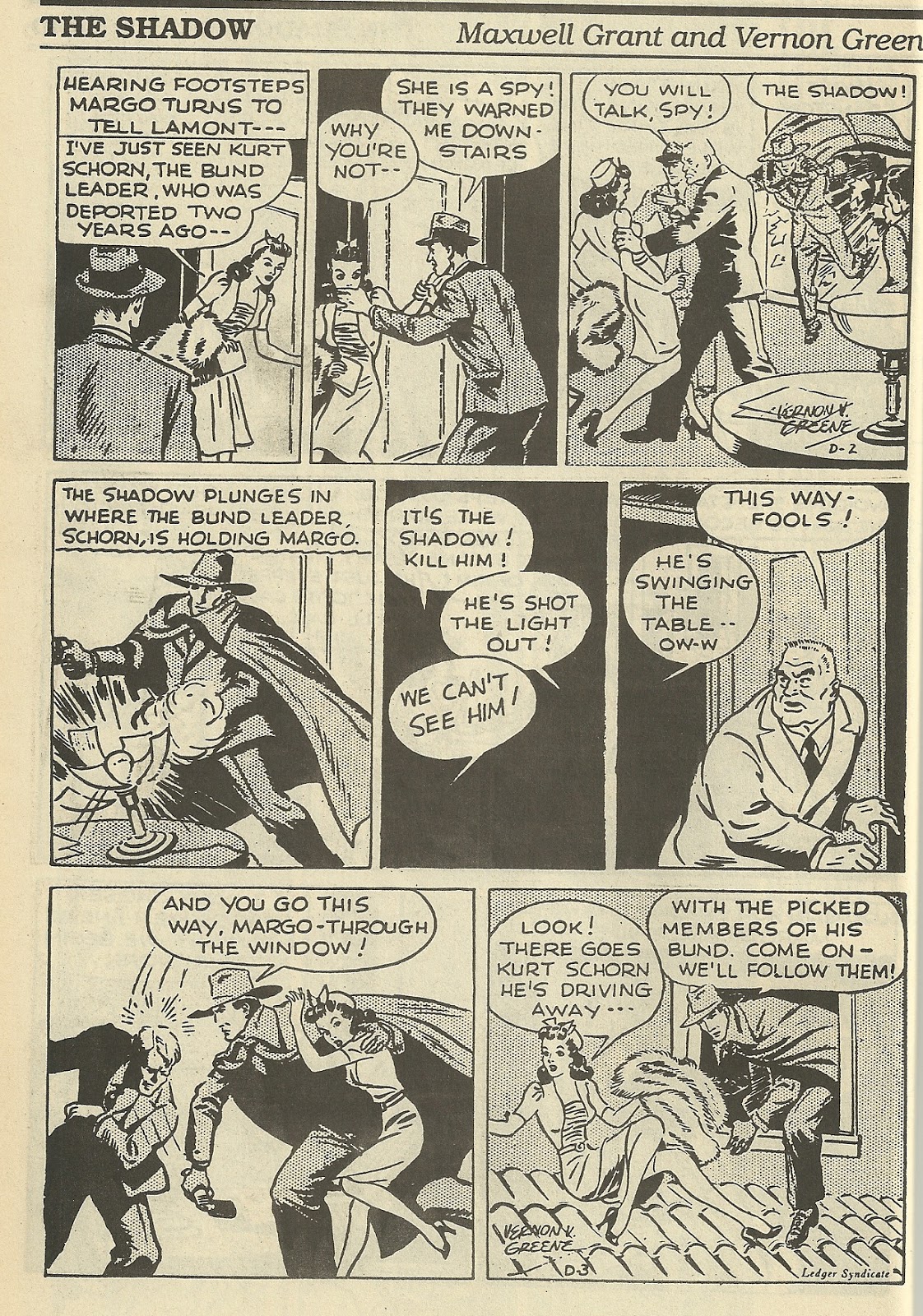
June 17, 1940 - June 13, 1942  The Shadow comic strip (syndicated through the Ledger Syndicate)


As you can see, The Shadow had an impressive print run from pulp magazines to comic strips from 1931 to 1949!

Sunday, December 3, 2017

The Shadow Strikes! (Part Two)

I had previously written about The Shadow Strikes! story as published by Belmont Books.  You can read that article here.  In this article I will dive into the character of The Shadow as presented in The Shadow Strikes!


Let me say at the very beginning that I consider the Belmont Books Shadow series to be a different iteration of The Shadow and not as a continuation of the stories from the pulp magazines.  I don't say that to diminish these stories because they are interesting and entertaining.  However, The Shadow in these stories is quite different than the ones from the pulps and the radio.  While there are many similarities, there are also major differences.

The Shadow in the Belmont Books is a man of mystery.  He wears the black cloak, the black slouch hat, and the girasol ring.  His footwear is described as "...Oriental slippers, designed for the needs of judo and karate..." (page 67).  These Oriental slippers allow The Shadow to make no sound as he walks.  The Shadow also carries a .45 automatic and keeps a ring of skeleton keys hidden in the folds of his cloak.  The Shadow's cloak, hat and ring are "folded into amazingly small size and hidden in their secret places within the clothes" of Lamont Cranston (page 12).

A major difference about this Shadow is that he has to wear the cloak, hat, and ring to become The Shadow.  For it is only when he wears these items that he has the full powers and abilities of The Shadow!  


From page 13 of The Shadow Strikes!

The Shadow is described as having great muscular control, physical strength, agility, balance and hearing.  He has knowledge of many languages (pages 30, 59).  He had studied in the Orient with several masters.  From the great Chen T'a Tze he learned the ability to cloud men's minds so as not to see him and to hypnotize them (but can only do so when wearing the cloak, hat and ring).  Master Chen T'a Tze had also taught him the art of shallow breathing, allowing him to slow down his breathing.  The Shadow has "remarkable recuperative powers" and knowledge of Oriental medicine that allows him to quickly recover from physical injury.  

Additionally, in the Orient, The Shadow learned "the secret of bearing pain to the point of actually not feeling any but the most intense and sudden pain.  It had been the most difficult of the mysteries of Chen T'a Tze for The Shadow to master" (page 82).  The Shadow is also able to put himself into a trance-like state of suspended animation that makes him appear as if he had died.   Not much information is provided about Chen T'a Tze other than he was a great Master who had trained Lamont Cranston in many ancient mysteries.

Some of the descriptions of The Shadow hearken back to the pulp magazine.  His face is not seen but his glowing, burning eyes can be.  The Shadow gives his sometimes mocking and sometimes triumphant laugh which chills the blood of the bad guys.  The Shadow is also a master of disguise, and in this story he disguises himself as explorer Kent Allard and Phineas Twambley (a disguised used in several of his pulp magazine adventures).  The Shadow uses a couple of his well known catch phrases:  "The weed of crime bears bitter fruit" (page 112) and "The Shadow knows what evil lurks in the hearts of men" (page 127).

The Shadow's primary alter-ego is Lamont Cranston.  As Cranston, he is wealthy socialite business man, amateur criminologist, and close friend of NY Police Commissioner Weston.  In the book Cranston is described as having hawklike features, long fingers, and greying blond hair.  He has a private office in a Park Avenue building which also doubles as his secret base of operations.  Cranston also owns a town house with a private garage.  He is a wine connoisseur and has financed Kent Allard's expeditions.  This Lamont Cranston seems to be an amalgamation of the Cranston from the pulps and radio show!

Kent Allard is the other alter-ego used by The Shadow.  There is a real Kent Allard who is an explorer and adventurer, so The Shadow assumes his identity.  To become Kent Allard, The Shadow uses a sophisticated disguise (pages 102-103)!  He uses a special dye to darken his hair and combs his hair straight back with no part.  If he has time, he will grow a mustache or use a fake mustache if in a hurry.  He injects a small wax-like fluid into the skin of his nose to change it from the hawklike nose of Cranston and into the thicker nose of Allard.  He uses his great muscle control to change his facial expression to that of Allard's and to walk slightly hunched over as Allard does due to the years of carrying heavy packs on his expeditions.  Finally, when disguised as Allard, The Shadow walks with a limp as the real Allard does as a result of a tiger attack while exploring the High Himalayas.  This is a clever reversal from the pulp magazines!  In the pulps, The Shadow is really Kent Allard but uses Lamont Cranston's identity.

The Shadow of the Belmont Books series is an interesting character that retains some of the qualities found in the pulps and the radio show.  However, you can see there's a lot of differences as well.  In my opinion, this Shadow was in direct competition with the likes of James Bond and other spies that were popular in the movies and on TV when this series was published.    While I enjoyed reading this book I found myself missing the classic Shadow character from Walter B. Gibson's works.  I plan on reading the entire Belmont Shadow series and writing about them here on the blog.  I hope you found this article informative and entertaining!


Saturday, November 18, 2017

The Shadow Strikes! (Part One)

Front Cover

The Shadow Strikes was the second Shadow paperback published by Belmont Books.  It was published on October 1, 1964.  Although it has Maxwell Grant as the author, it was actually written by Dennis Lynds.

Back Cover
This Shadow adventure is a clear departure from all other published Shadow stories up to this time.  While Shadow fans will recognize many of the names and places from previous stories, they will also see that things have changed and this story was set in a contemporary setting (1960s).  

In this story, The Shadow investigates the death of a man named Anton Pavlic.  While the police claim Pavlic died as a result of accidental murder (he was hit by a car!), The Shadow knows there is something more sinister behind the simple facts.  His investigation leads to the unveiling of a blackmail scheme being run by an organization that, on the front, was set up to help refugees from communism.

The Shadow drives a Jaguar.  It is a small, custom-built car with a supercharged engine.  It is also equipped with a car telephone!

1964 Jaguar - could this be The Shadow's?

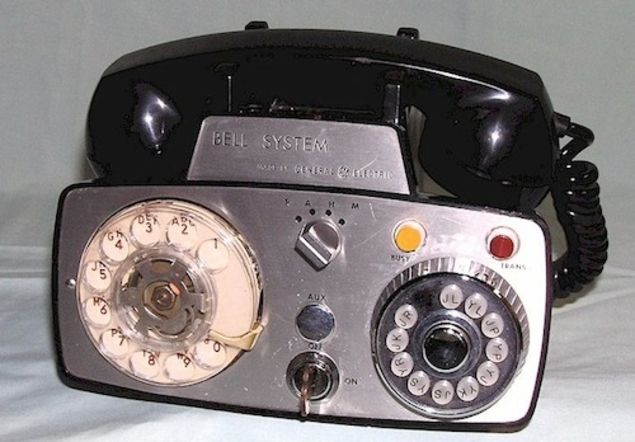
1964 Car Phone

I did a little research and was amazed to find that in 1964 there were over 1 million Americans using car telephones!  Above is an example of a 1964 car phone, but I'm sure The Shadow's was more high-tech than what you would buy over the counter!

As I mentioned, there are familiar faces and places in this Shadow story.  We have Lamont Cranston visiting the Cobalt Club.  Cranston is a good friend of Police Commissioner Weston, and in this story Cranston assists Detective Joe Cardona.  All of these characters and places are straight from The Shadow pulp and radio stories.

The Shadow also has a team of agents that assist him, just as he did in the pulps.  But again, there are some updates and changes.  Here are The Shadow's agents from The Shadow Strikes:

Stanley:  Stanley is The Shadow's chauffer and is an ex-police officer.  He carries an automatic, handcuffs and lock picks. (Stanley was Lamont Cranston's chauffer in the pulp magazines.)

Burbank:  Burbank is the hub of The Shadow's team as agents report to Burbank and Burbank reports to The Shadow.  

Shrevvy:  Shrevvy is described as a small, peppy taxi driver.  He assists The Shadow with transportation needs.

Clyde Burke:  Clyde is a reporter as well as friend and associate of The Shadow.

Margo Lane:  Margo is described as dark-haired and slim.  She is the private secretary of Lamont Cranston as well as a friend and operative of The Shadow.  Margo is from Denver, Colorado and was a theater major in college.  She goes under cover to assist The Shadow in this story. 

Unlike the pulp magazines, The Shadow's agents listed above all know his identity and are a part of his crime fighting organization.  I'll write more about The Shadow in an upcoming article!

This was an exciting and well-written story.  While it was a departure from the historic Shadow character, I liked it as a new iteration of The Shadow.  It wasn't quite the page-turning adventure I enjoy from Walter B. Gibson, but it was a fun and entertaining book to read.

In an upcoming article I will write extensively about The Shadow in this story and highlight his character, gadgets and abilities.  I hope you've enjoyed this brief look at The Shadow Strikes!!!


Sunday, November 12, 2017

The Shadow's Weapon: The Devil's Whisper

In his war against crime, The Shadow has a variety of weapons!  I previously looked at his .45 automatics, and in this article I want to take a brief look at one of his defensive weapons known as The Devil's Whisper.

From Nostalgia Ventures The Shadow #12

The first time The Shadow uses The Devil's Whisper is in the story, "The Red Menace" which was first published on November 1, 1931.  In this story, The Shadow uses it twice!  The Devil's Whisper is created by placing two chemicals on his fingers, one chemical on his thumb and another chemical on his third finger.  When The Shadow snaps his fingers, it results in a flash of flame and a sharp explosion sounding like the shot of a pistol.  It temporarily stuns The Shadow's opponent, allowing him to take quick action against them.  


Description of The Shadow's use of The Devil's Whisper

The Devil's Whisper was a well-known and dangerous magic trick at the time of The Shadow's story.  According to an article by Anthony Tollin in The Shadow #12 published by Nostalgia Ventures (October 2007), Walter B. Gibson tells readers that The Devil's Whisper was eventually pulled off shelves because a magician used too much of the compound when demonstrating it to a friend and ended up losing his hand, knocking both men unconscious, and making the office look like a bomb had exploded in it!

The Shadow let Maxwell Grant know that he had perfected the right amount of chemicals and their usage so that he can create the exact effect he wants!  


The Shadow knows...how to use The Devil's Whisper!

The Shadow uses The Devil's Whisper as a defensive weapon.  It was a well-known magic trick that The Shadow improved on and incorporated into his arsenal!  It's bright flash and loud bang temporarily stuns The Shadow's opponent and allows The Shadow to take quick action.  

Below is a brief video showing a modern version of The Devil's Whisper!


Thursday, November 2, 2017

Clews or Clues?

If you read any of the old Shadow magazines or their reprints, you'll find the word 'clew' is used instead of the word 'clue.'  The first time I read 'clew' I simply thought the editors were hooked on phonics and that's how they spelled it consistently throughout the story.  But as I've read more of The Shadow's adventures, I noticed that 'clew' was always the word used for 'clue.'  

I had always intended on doing a little research into the difference between 'clew' and 'clue' but never got around to it.  Today, however, the Merriam Webster word of the day was 'clew!'  I thought that was awesome and just had to share it on the blog!


Here's what Merriam Webster has to say about 'clew':

  • noun:  something that guides through an intricate procedure or maze of difficulties : clue


They go on to provide a bit of a background for the word:  

  • The "ball of thread" meaning of clew (from Middle English clewe and ultimately from Old English cliewen) has been with us since before the 12th century. In Greek mythology, Ariadne gave a ball of thread to Theseus so that he could use it to find his way out of her father's labyrinth. 
  • This, and similar tales, gave rise to the use of clew for anything that could guide a person through a difficult place. 
  • This use led, in turn, to the meaning "a piece of evidence that leads one toward the solution of a problem." 
  • Today, the variant spelling clue, which appeared in the 17th century, is the more common spelling for the "evidence" sense, but you'll find clew in some famous works of literature. 


I thought this was very interesting and wanted to share it here on the blog.  I didn't have a clue about the background of the word clew, and now I do!