Monday, June 18, 2018

The Shadow: Biography According to the Belmont Book Series

I consider the Belmont Books Shadow series to be a different iteration of The Shadow and not as a continuation of the stories from the pulp magazines.  I don't say that to diminish these stories because they are interesting and entertaining.  However, The Shadow in these stories is quite different than the ones from the pulps and the radio.  While there are many similarities, there are also major differences.  (Please note that the information below is based on descriptions of The Shadow from The Shadow Strikes.)


The Shadow in the Belmont Books is a man of mystery.  He wears the black cloak, the black slouch hat, and the girasol ring.  His footwear is described as "...Oriental slippers, designed for the needs of judo and karate..." (The Shadow Strikes page 67).  These Oriental slippers allow The Shadow to make no sound as he walks.  The Shadow also carries a .45 automatic and keeps a ring of skeleton keys hidden in the folds of his cloak.  The Shadow's cloak, hat and ring are "folded into amazingly small size and hidden in their secret places within the clothes" of Lamont Cranston (The Shadow Strikes page 12).

A major difference about this Shadow is that he has to wear the cloak, hat, and ring to become The Shadow.  For it is only when he wears these items that he has the full powers and abilities of The Shadow!

The Shadow is described as having great muscular control, physical strength, agility, balance and hearing.  He has knowledge of many languages (The Shadow Strikes pages 30, 59).  He had studied in the Orient with several masters.  From the great Chen T'a Tze he learned the ability to cloud men's minds so as not to see him and to hypnotize them (but can only do so when wearing the cloak, hat and ring).  Master Chen T'a Tze had also taught him the art of shallow breathing, allowing him to slow down his breathing.  The Shadow has "remarkable recuperative powers" and knowledge of Oriental medicine that allows him to quickly recover from physical injury.

Additionally, in the Orient, The Shadow learned "the secret of bearing pain to the point of actually not feeling any but the most intense and sudden pain.  It had been the most difficult of the mysteries of Chen T'a Tze for The Shadow to master" (The Shadow Strikes page 82).  The Shadow is also able to put himself into a trance-like state of suspended animation that makes him appear as if he had died.   Not much information is provided about Chen T'a Tze other than he was a great Master who had trained Lamont Cranston in many ancient mysteries.

Some of the descriptions of The Shadow hearken back to the pulp magazine.  His face is not seen but his glowing, burning eyes can be.  The Shadow gives his sometimes mocking and sometimes triumphant laugh which chills the blood of the bad guys.  The Shadow is also a master of disguise.    

The Shadow's primary alter-ego is Lamont Cranston.  As Cranston, he is wealthy socialite business man, amateur criminologist, and close friend of NY Police Commissioner Weston.  In the book Cranston is described as having hawklike features, long fingers, and greying blond hair.  He has a private office in a Park Avenue building which also doubles as his secret base of operations.  Cranston also owns a town house with a private garage.  He is a wine connoisseur and has financed Kent Allard's expeditions.  This Lamont Cranston seems to be an amalgamation of the Cranston from the pulps and radio show!

Kent Allard is the other alter-ego used by The Shadow.  There is a real Kent Allard who is an explorer and adventurer, so The Shadow assumes his identity.  To become Kent Allard, The Shadow uses a sophisticated disguise (The Shadow Strikes pages 102-103)!  He uses a special dye to darken his hair and combs his hair straight back with no part.  If he has time, he will grow a mustache or use a fake mustache if in a hurry.  He injects a small wax-like fluid into the skin of his nose to change it from the hawklike nose of Cranston and into the thicker nose of Allard.  He uses his great muscle control to change his facial expression to that of Allard's and to walk slightly hunched over as Allard does due to the years of carrying heavy packs on his expeditions.  Finally, when disguised as Allard, The Shadow walks with a limp as the real Allard does as a result of a tiger attack while exploring the High Himalayas.  This is a clever reversal from the pulp magazines!  In the pulps, The Shadow is really Kent Allard but uses Lamont Cranston's identity.

The Shadow of the Belmont Books series is an interesting character that retains some of the qualities found in the pulps and the radio show.  However, you can see there's a lot of differences as well.  In my opinion, this Shadow was in direct competition with the likes of James Bond and other spies that were popular in the movies and on TV when this series was published (1960s).   


Saturday, June 9, 2018

The Shadow Magazine #275

Recently I was able to add another original Shadow magazine to my collection.  It is the January 1944 issue (the 275th issue in The Shadow series) which features the story, "The Mystery of the Crystal Skull."


When I first opened the package it came in, I was surprised!  The magazine was so much smaller than other issues I have.  It is physically smaller, as you can see in the picture below where I compare it with the July 1, 1941 issue.  It has 130 pages compared to the July '41 issue that has 114 pages.   By this time The Shadow was no longer a bi-monthly publication as beginning with the March 1943 issue, it had transitioned to monthly publication.  (Based on some research I did, the paper shortage during WW2 had a significant impact on magazines and comics published during the war years.   Paper, gasoline, rubber and even food was rationed during the war years.  Please see this brief article here for some good info!)


The magazine's cover tells us what the inside story is, "The Mystery of the Crystal Skull."  The artwork shows a skull, but I notice that The Shadow is missing!  The price is 15 cents - that's up from the 10 cent price of the 1941 issue.

The table of contents indicates it features a full novel length story of The Shadow and two novelettes (short stories).  It also has several special features, including Codes by Henry Lysing.  I personally wish the Codes section of The Shadow magazine would be included in The Shadow reprints that are available.  Finally, it has a feature called The Shadow Says.  What I don't see is any reference to The Shadow Club or Highlights on The Shadow as have been in other issues.


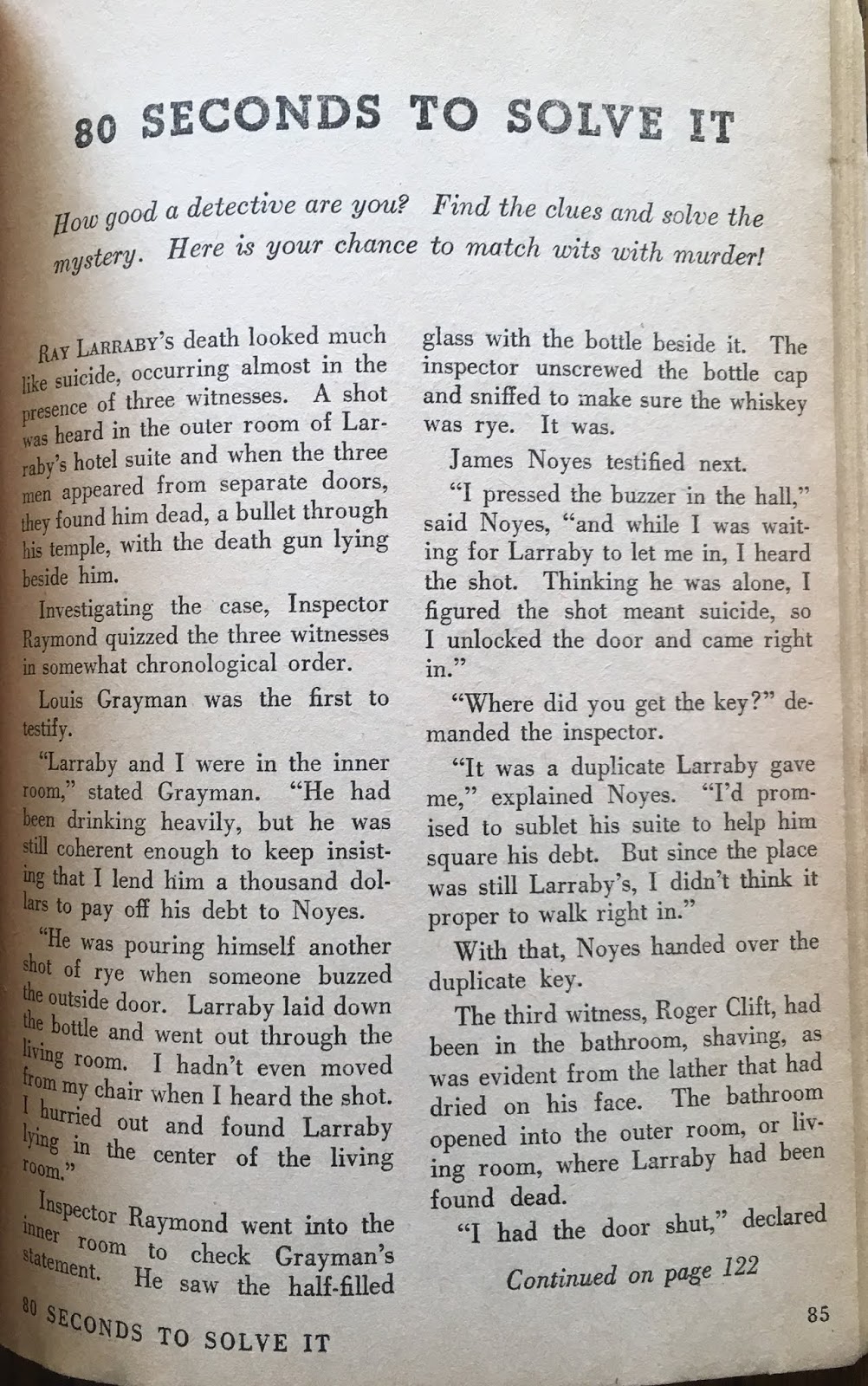
Here are some pages from inside the magazine.  (Sorry the pictures aren't that great.  The binding on this issue is starting to come apart so I was being careful to not cause any more damage.)


The back cover is a full page ad for Calvert.


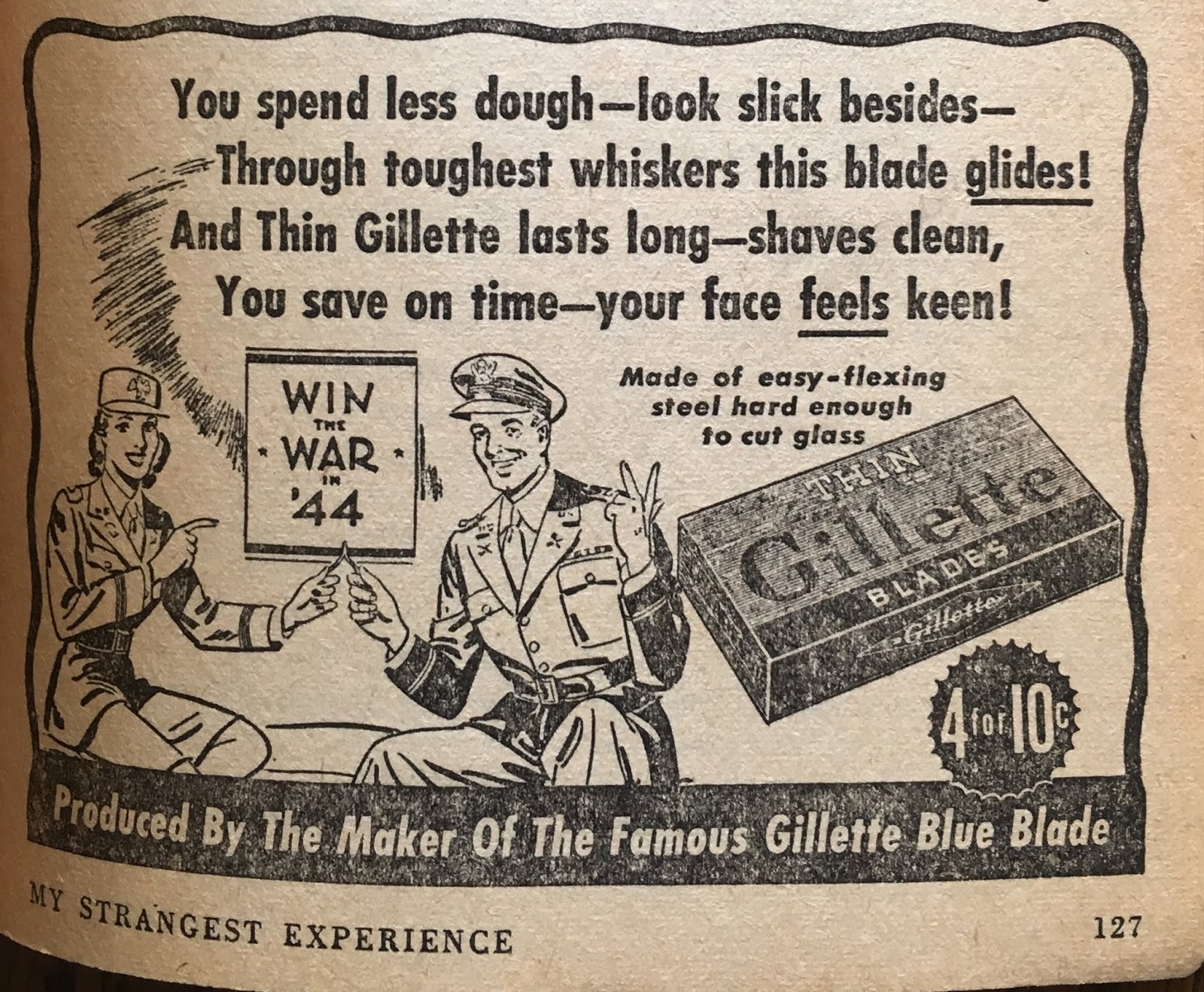
Inside are ads for Listerine and Gillette, and a reminder from Uncle Sam on price controls for the war effort.


I found most interesting the feature called The Shadow Says which is on page 6.  It leads me to believe that this issue may have been the first, or one of the first, issues that were a smaller size (what they call a 'handy size.')  It says, "In the transition from the larger book, to this present handy size, many adjustments were necessary."  Another interesting part of The Shadow Says is a defense of the character Margo Lane!  If you remember, Margo Lane was first a character on The Shadow radio show that began in 1937.  She made her first appearance in The Shadow magazine in the June 15, 1941 issue.  Newer fans to The Shadow loved her appearance in the pulp while other long-time Shadow fans hated her inclusion.  Well, it appears there are still complaints about the lovely Margo Lane in 1944!  It says in part, "Now we come to Margo Lane!  Good old Margo is in trouble again with some readers and defended by others."  The writer does a good job of painting a picture of the love/hate relationship fans have with Margo!


This issue of The Shadow magazine was an eye opener for me!  It gives us insight into what was happening in our nation during the war and its impact on The Shadow magazine.  It also shows the on-going controversy of including Margo Lane in The Shadow magazine!


Sunday, June 3, 2018

The Shadow's Personal Physician


This weekend I was reading The Shadow story, "The Thunder King" (first published on June 15, 1941) and came across an interesting Shadow fact!

In the story, The Shadow, disguised as Lamont Cranston, is injured and taken to a hospital.  The Shadow knows he must get out of the hospital to continue his hunt for the vicious criminal of the story.  That's when we learn the following:

"Dr. Rupert Sayre was Cranston's physician, which meant, in a sense, that he was in The Shadow's service.  In fact, if it hadn't been for The Shadow, Dr. Sayre would never have had Cranston as a patient.  Nor would Sayre have had the very fine practice that came from Cranston's friends.

In fact, Sayre wouldn't even be alive.  He owed his life to The Shadow, who had pulled him out of a very bad jam several years before.

As a result, Sayre was always ready to do favors for The Shadow, or for Lamont Cranston, for he knew that they were either one and the same man, or very closely associated."*

I've not done any further research, but I don't believe Dr. Sayre was considered one of The Shadow's agents.  But he did owe his life to The Shadow, just like almost every one of his agents!  Like many of those close to The Shadow, he believed Cranston was The Shadow (Henry Vincent thought this as well!).  I thought this was a very interesting Shadow fact tucked away in this story! 

* The Thunder King and The Star of Delhi: Two Classic Adventures of The Shadow, by Maxwell Grant et al., vol. 68, Sanctum Books, 2012

Monday, May 28, 2018

New Blog - The Shadow Radio!

I was able to obtain the domain theshadowradio.com and decided I would create a blog with that domain that would be based entirely on The Shadow radio show.  Today I started building that blog and posted one article on it just to get it started.  My plan is to take any posts related to The Shadow radio show on this blog and put it on The Shadow Radio blog.  Going forward, anything related to The Shadow radio show will be posted on the new blog.  I hope you take some time to check in on the new blog as I continue to build it and post new content to it!


The History Behind the Mystery: The Red Menace and The Romanoff Jewels


This year I read "The Red Menace" and "The Romanoff Jewels."  Both of these stories are fantastic Shadow adventures!  But when I finished reading them, I felt like I was missing something in my understanding of the stories.  That led me to start digging into the background of both adventures and a study of Russian history.  The more I studied and learned, the more I began to appreciate these two Shadow stories.  Let me share some of that background with you!  Please note that some of what I share is in general terms to try and simplify some of the complexities I discovered.


Up until 1917, Russia was ruled by powerful Tsars from the Romanoff (Romanov) dynasty.  The last Tsar of Russia was Tsar Nicholas II who began to reign on November 1, 1894.  In the early 1900s there was a lot of unrest in Russia and missteps by Tsar Nicholas didn't help endear him to the people.  For example, his handling of Russian involvement in World War I was a fiasco leading to the deaths of approximately 2 million ill-equipped Russian soldiers.  

Tsar Nicholas II

In February of 1917, the first of two revolutions began.  The February revolution began when workers refused to work and started rioting.  Troops were sent in to suppress the riots, but many soldiers refused and much of the army eventually turned against the Tsar.  As a result, Tsar Nicholas II abdicated his monarchy on March 15, 1917.  Shortly after his abdication, Nicholas and his family were imprisoned.  Two factions began to run the Russian government; the Petrograd Soviet (also known as Bolsheviks - which represented workers, soldiers) and the Provisional Government (which supported the Tsar and the monarchy).   In October of 1917, the second revolution began as the Petrograd Soviet led an armed insurrection that deposed the Provisional Government and assumed all command and authority in Russia.  Shortly after the October revolution, a civil war broke out in Russian between Red armies (Bolsheviks, socialists, communists) and the White armies (Russians who supported the Tsar and the monarchy).  The Red army defeated the White army and in 1922 Russia officially became the Union of Soviet Socialists of Russia (USSR).

On July 17, 1918, Tsar Nicholas II and his entire family were murdered by Bolshevik soldiers in the basement of a home in Yekaterinburg, Russia.  

Here's a brief summary to try and sum all of this up:

  • The Romanoff dynasty ruled over Russia as a monarchy for over 300 years
  • Tsar Nicholas II was the last Tsar of Russia and was killed on July 17, 1918
  • Russians that supported Tsar Nicholas and the monarchy were called "Tsarists" or "White" Russians
  • Russians that opposed the Tsar/monarchy were called "Bolsheviks" or "Red" Russians
  • Tsarists who remained in Russia had their wealth confiscated by the Reds, this led to many Russians of nobility fleeing Russia (with their wealth) for other nations, including the United States

Now let me try and fold all this background into The Shadow stories!  In "The Red Menace" we learn that The Shadow was inducted into a secret society of Royalist (Tsarist) Russia called the Seventh Star.  The Shadow tells us, "I was in Russia during the first months of the War.  As an agent of another government, I became a member of the Seventh Star."  Under the stone of The Shadow's girasol ring is engraved a seven pointed star, which is the symbol of this elite organization!

In "The Romanoff Jewels" we learn a little more about The Shadow's connection with Russia.  The Shadow shows his girasol ring and tells us that the fire opal was given to him as a gift from the Tsar and it is one of the jewels of the Romanoffs.  "Gaze upon the stone that gleams from my finger.  That priceless girasol was once owned by the Tsars of Russia...The girasol was a gift, which I accepted as a memento of friendship from the man who owned it..."

From these two stories we learn that The Shadow had known and assisted in some way Tsar Nicholas II.  For his actions, he became a member of the Seventh Star and was given a priceless girasol ring.  If you go on to read these stories, try to keep in mind the different factions in Russia (Reds, Whites) as it leads to the intrigue and plotting that happens in these stories.

It was exciting and educational to do this investigation and research on the background of these two Shadow adventures.  I hope you've enjoyed the history behind the mystery!


Sunday, May 20, 2018

The Collected Shadow Comic Strip

The Shadow began to appear in newspaper comic strips (through the Ledger Syndicate) on June 17, 1942.  The stories were written by Shadow creator Walter B. Gibson and the artwork was provided by Vernon Green.  Unfortunately the comic strip was ended after only two years of publication.  According to one account, it was ended due to the impact of World War II on newspapers - needing more room for war news and printing fewer papers due to the paper shortage.

In 1988, Eternity Comics began publishing The Shadow comic strips in a collection entitled, Crime Classics.  There are 13 issues, with the final issue publishing in November of 1989.

I was able to find a copy of Crime Classics #1, here are a few pictures from the comic.

Front Cover

Inside Front Cover


I like that the stories are written by Walter B. Gibson and the artwork is pretty good.  I can imagine the difficulty in taking a book-length Shadow novel and trying to make it appealing in comic strip form.  However, some of the depictions of The Shadow aren't that great - like in the photo above where The Shadow says, "My own automatic!"  I'm trying to figure out what that is covering his face!  But the picture below it is awesome - classic Shadow!

If you want to read all The Shadow comic strips, I recommend you get your copies of these Crime Classics!


Sunday, May 6, 2018

The Shadow Radio: The Tenor With The Broken Voice


Here's a brief synopsis and notes of The Shadow radio episode, "The Tenor With The Broken Voice" that originally aired on June 5, 1938.  (Note:  I've seen other dates listed as the original air date, but the June 5 date is based on what I found at a vintage radio log.)

Margo Lane and Lamont Cranston attend a night at the opera to watch the opera "Pagliacci."  They both comment on their anticipation to hear the star, Hagen Radcoffe, as he sings the aria "Vesti la giubba" which closes out the first act.  As Radcoffe sings the aria, the audience is shocked as Radcoffe's voice cracks and he is led off the stage.  

Replacement singers are brought in for other performances and death and tragedy strike them as they sing the "Vesi la giubba" aria.  Cranston, as The Shadow, investigates and foils the villain before he can set off an explosion in the crowded opera house!

It's interesting to see the conflict between Commissioner Weston and The Shadow as they both work to solve the crime and keep the public safe.  I also enjoyed hearing Detective Joe Cardona and The Shadow's agent, Clyde Burke, in this adventure.

Cast/Crew:
Lamont Cranston/The Shadow:  Orson Wells
Margo Lane:  Margot Stevenson

Announcer:  Ken Roberts (some have noted that Roberts may have played the part of one of the tenors in this episode!)

Sponsor:  B. F. Goodrich